The Genre
Five Flames Don't Make a Five-Star Read
A heat rating and a star rating are answering two completely different questions — and mixing them up is how you end up disappointed by a five-flame letdown or blindsided by a quiet book that wrecks you.

You picked it because it was rated five flames. The comments called it unhinged, filthy, worth the hype. You cleared your evening, settled in, and forty pages later realized the sex was the only thing holding the story up. The plot was thin. The dialogue was doing nothing. By the time you closed the book you were somehow both satisfied and disappointed, and you couldn't explain why until the actual problem surfaced: the flame rating told you exactly what you'd get in bed, and told you nothing about whether the book was any good.
Then a friend recommends something rated a single flame, closed-door, practically Victorian by comparison, swearing it's the best thing she's read all year. You almost skip it. It wrecks you in a way the five-flame book never came close to.
Same shelf. Same rating systems. Completely different jobs.
What a Flame Count Is Actually Measuring
A heat rating answers one narrow question: what's on the page. Nothing. Something implied, then the door closes. One scene handled with restraint. Or scenes that keep coming until the acknowledgments. That's the whole job a flame count was hired to do.
Heat ratings were never a universal measurement system. A five-flame rating on one site or reader-made chart can mean something noticeably different from a five-flame rating somewhere else. The number looks standardized. The scale underneath it often isn't.
Two Books, Same Rating, Nothing Else in Common
Take two books, both marketed as five-flame, both shelved under the same tag.
The first opens the door once, late, after two hundred pages of tension so tight you're gripping the book like it owes you something. When it finally happens, it changes everything about how the two characters see each other. One scene. Everything after it is different because of it.
The second opens the door in chapter two and keeps it open. Scene after scene, explicit and frequent, with barely a paragraph of plot holding them apart. It's a completely different kind of five-flame book than the first one.
Same rating. Two entirely different reading experiences, and the number gave you no way to tell them apart.
When the Heat Is the Point, and When It Isn't
Sometimes the explicit content is one thread in something bigger — the tension between two people who are also solving a murder, running from a cartel, slowly falling apart and back together while the plot keeps moving underneath them. Sometimes the heat is the plot, structurally, the same way the action in an action movie is really the connective tissue between the parts everyone actually paid to see. Both are valid shapes for a five-flame book to take, and the flame count alone leaves you guessing which one you're holding until you're already forty pages in.
The Mix-Up That Actually Costs You Something
Here's the one worth sitting with directly: dark doesn't mean spicy, and spicy doesn't mean dark. A book can be soaked in obsession and captivity, with a hero who scares you in the good way and the bad way both, and stay closed-door the entire time. The darkness lives in the stakes and the psychology, rather than the explicitness. A book can also run blisteringly, constantly explicit and carry zero dark content at all — just two people who like each other a great deal, saying so with enthusiasm.
Which is exactly why a heat number makes a poor stand-in for a consent warning. Dubcon and non-con need their own vocabulary entirely. A five-flame tag is meant to communicate explicitness, and every time someone treats it like a shortcut for what actually happens between two characters, a reader ends up somewhere she didn't agree to go.
What a Star Rating Is Actually Doing
A star rating is a reader telling you how the whole thing landed. The prose, the pacing, whether the ending earned the three hundred pages before it, whether she closed the book and immediately needed to talk to someone about it. Explicitness only enters that equation if the reader lets it in. Two women can give the same book the same five stars for reasons that have nothing to do with each other — one for the ache, one for the ending, one because the villain said one line that lived in her head for a week.
Two Sites, Two Different Attempts to Fix This
Goodreads gives you one number and a blank box. Whatever heat information exists lives buried in someone's paragraph, a review, or a reader-question thread you have to dig for yourself.
StoryGraph pulls the experience apart into more of its actual pieces — mood, pace, whether the book is plot- or character-driven, a content-warning system that sits separately from the star rating instead of folding into it. Readers have specifically requested a dedicated heat field on top of all of that, which tells you something on its own: readers already know these are two different questions. They're tired of needing two websites and a group chat to get both answers.
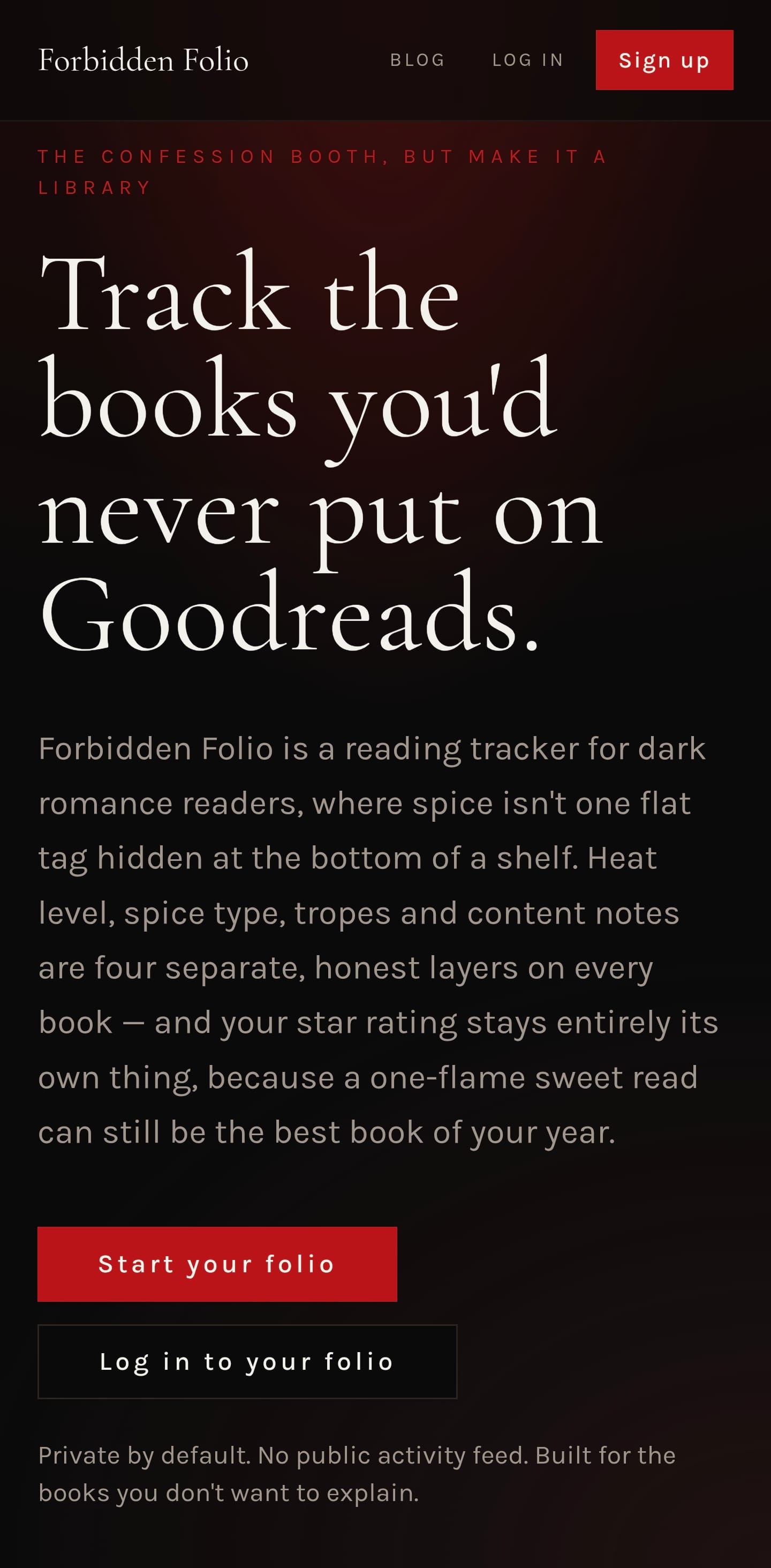
Forbidden Folio was built around the exact problem this essay is describing. Heat, darkness, and your own star rating live as separate fields, not one number pretending to do three jobs. Log the flame count. Log how you actually felt about it. Never make one stand in for the other again.
Four Books That Prove the Point
Pride and Prejudice has no sex on the page, and it still gets crowned, year after year, as one of the greatest love stories ever written. Low explicitness never got in the way of the romantic impact.
Boyfriend Material by Alexis Hall is a useful counterexample to the assumption that a romance needs explicit scenes to earn five stars. Readers adore it for the ache, the banter, and the emotional payoff.
Fifty Shades of Grey proves the opposite point: extreme explicitness guarantees attention, and it guarantees nothing about consensus. Readers who love the heat and readers who can't get past the prose are often the same readers, arguing with themselves in the same review.
Haunting Adeline runs hot enough to need its own warning label, and it produces genuinely divided reactions — some readers call it an unforgettable, feral obsession of a book, others find the plot thin underneath all that heat. Extreme content doesn't produce a universal response. It produces a fault line.
The Fields, Side by Side
| Field | What it tells you | What it can't tell you |
|---|---|---|
| Heat/flames | How explicit and how frequent the intimacy is | Whether the writing is good, or whether you'll love it |
| Content warnings | What darker or heavier material shows up | How graphic anything actually is |
| Star rating | How one reader felt about the whole book | The heat level, or a universal verdict on quality |
| Mood and tropes | The emotional shape of the story | Whether or how much sex happens on the page |
Laid out like that, the problem stops being abstract. Every one of these fields is doing honest work, and none of them was built to cover for the others. The mistake was never in the ratings themselves. It's in expecting one of them to answer a question it was never assigned.
Which Number to Trust, and When
Reader Fit
- Want to match your mood?
- Trust the flame count when you're deciding whether tonight's mood matches tonight's book.
- Want a worthwhile read?
- Trust the star rating when you want to know if the story itself is worth your time.
- Need to know about consent/darkness?
- Trust neither one alone when you need to know about consent, darkness, or a specific dynamic. Go find the content warnings instead — that's their job.
Where This Leaves You
The flame count tells you what to expect on the page.
The star rating tells you how the whole thing felt once you'd closed the book.
They were built to answer different questions, and every time they get treated like the same number, a reader ends up either let down by a five-flame book with nothing underneath it, or blindsided by a quiet one-flame story she never saw coming.
Which one were you actually asking about — how much heat, or how good?
FAQ
Does a high spice rating mean a book is better?
It means more explicit content is on the page. Quality is a separate question, answered by the writing, the characters, the structure, and whether the book earned the feeling it was going for.
Can a closed-door romance really be a five-star read?
Yes. Plenty of readers give five stars to books that never open the bedroom door, because the ache, the banter, the emotional payoff, or the prose did the work.
Is dark romance always spicy?
No. Darkness lives in the stakes and the psychology. Explicitness is optional.
Does a high flame count mean dubcon or non-con?
No. Those require their own clear warnings. A heat rating measures explicitness, and stops there.
Why does the same book get such different heat ratings on different sites?
Because there's no shared scale. Every chart is a local dialect. The number only means something inside the system that produced it.
The Scarlet Pages is the editorial publication of Luxuria Obscura — for the girls who like it dark.
The newsletter
Join the letter
A literary publication from Luxuria Obscura. Essays on dark romance, psychology, and the reader who never apologized for her taste.



Member discussion